ABOUT
SARRAH ROSE
THE QUESTIONS THAT FOLLOWED ME
I've spent much of my life interested in what happens after we get what we thought we wanted.
Success. Love. Beauty. Recognition. Money. Marriage. Achievement.
We spend enormous amounts of our lives pursuing the things we believe will make us feel fulfilled. And yet, after more than a decade working intimately with highly accomplished people, I've seen how often getting what we want fails to answer the deeper questions underneath the pursuit.
Who am I when achievement is no longer enough to tell me who I am?
What makes a life feel meaningful rather than merely successful?
What allows us to love without abandoning ourselves?
Why can someone have everything they once wanted and still feel that some part of them has gone missing?
My work has increasingly become an exploration of those questions—and of what it means not simply to build a successful life, but to become more fully alive within it.
-
Long before I had language for it, I was interested in desire: what people want, what we believe those things will give us, and what happens when we finally have them.
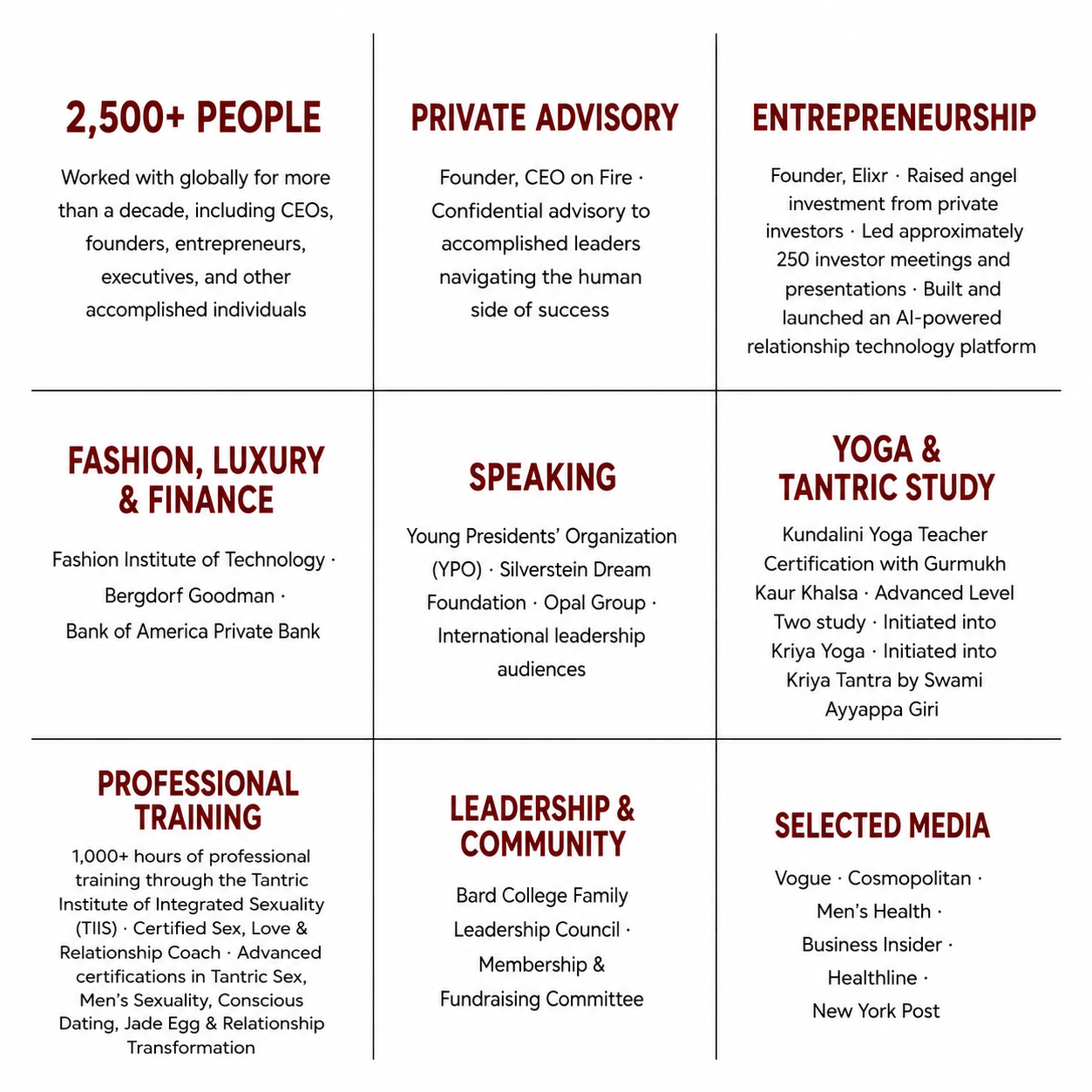
I moved to New York as a teenager to model and later began studying fashion at the Fashion Institute of Technology. While at FIT, I began practicing yoga—not simply as exercise, but as a way of life—and became increasingly interested in practices and traditions concerned with the inner experience of being human.
My work in fashion and luxury continued at Bergdorf Goodman, where I became a personal stylist working closely with affluent and high-profile clients. I later moved into private banking, working at Bank of America Private Bank.
At the time, I didn't think of these pursuits as connected. Looking back, I see a throughline.
The worlds I was moving through were all organized, in different ways, around desire.
Beauty. Status. Money. Achievement. Identity. Belonging. Power.
It was an early exposure to questions I would spend much of my life exploring: what we pursue, what those pursuits give us, and what they don't.
-
Over time, my questions became less about what people wanted and more about what shaped the wanting itself.
Why do we pursue certain lives, relationships, identities, and versions of success? Why can we know intellectually what we want to change and still find ourselves repeating the same patterns? Why do we abandon parts of ourselves in order to belong? And what allows us to become more present—to our bodies, our emotions, our relationships, our desires, and our lives?
That exploration eventually led me more deeply into yoga and Tantra. In 2013, I traveled to India, where I completed Kundalini Yoga teacher training with Gurmukh Kaur Khalsa. I returned in 2014 for advanced study and later continued that training with her in New York. My study expanded into other yogic and Tantric traditions, and in 2016, I received initiation into Kriya Yoga in the lineage of Paramahamsa Hariharananda and Paramahamsa Prajnanananda. In 2019, I received initiation into Kriya Tantra from Swami Ayyappa Giri.
What I encountered was a deeper way of understanding what it meant to be human. Tantra did not ask me to transcend life, but to participate in it—to inhabit the body, experience desire without being consumed by it, enter rather than avoid what frightened me, and become more conscious of how I was choosing to live. There was no other state somewhere else to attain. Life was already happening here.
I continued studying across disciplines, eventually completing more than 1,000 hours of professional training in sexuality, relationships, and coaching, alongside further study in human behavior, neurobiology, somatic theory, and foundational therapeutic principles. I brought those perspectives into conversation with what I was learning through Tantra and through my work with people. I wasn't looking for a single system that could explain us, but for a more integrated understanding of how human beings experience, protect, connect, desire, change, and express themselves.
That exploration eventually became the foundation of the Tantric Activation Method: my contemporary framework for exploring how we experience, participate in, and express a human life.
-
For more than a decade, I have had the unusual privilege of being invited into the parts of people's lives that are rarely visible from the outside.
I have worked with more than 2,500 people around the world, including founders, executives, entrepreneurs, and other highly accomplished individuals. They came to me with questions about love, sex, marriage, divorce, identity, desire, loneliness, ambition, family, meaning, and the complicated experience of being human while carrying enormous responsibility.
A person's external life tells us remarkably little about their internal experience of it.
I have sat with people who had built extraordinary companies but struggled to tell the person they loved what they needed. People surrounded by others who felt profoundly alone. People who had achieved nearly everything they once believed would make them happy and found themselves wondering why fulfillment remained elusive.
But I also saw what became possible when people stopped treating the different parts of themselves as separate problems to solve.
A relationship could reveal something about identity. Desire could expose a life that had become too constricted. Conflict could reveal where someone had learned to abandon themselves. Success could illuminate what achievement had been compensating for. Sexuality could become a doorway into parts of ourselves that were otherwise difficult to reach. Loss could reorganize what mattered. Love could ask someone to become more honest, more vulnerable, more powerful, or more fully themselves.
That understanding changed my work.
I became less interested in helping people perfect a particular area of life and more interested in the larger question underneath all of them:
What allows a human being to become more fully alive—and more fully expressed?
-
My work with people eventually led me to another question: Could what I had learned through thousands of intimate conversations be translated into something that could reach people beyond the room?
I built CEO on Fire as a private practice working with leaders and accomplished individuals navigating the human side of success. I developed the Tantric Activation Method as the philosophy and framework underlying much of that work.
Then, in 2022, I founded Elixr, a technology company exploring how artificial intelligence could support people in navigating love, relationships, and emotional wellbeing.
Building Elixr expanded my experience of entrepreneurship into an entirely different arena. For me, entrepreneurship has always been an act of creation: having an idea, believing in what it could become, and bringing together the people, resources, and action required to bring it into form.
I raised capital. Built a team. Pitched hundreds of investors. Developed a product. Entered the rapidly changing world of artificial intelligence. Made difficult decisions with incomplete information.
It gave me a different vantage point on many of the questions I had spent years exploring through my work: desire, ambition, identity, risk, power, responsibility, and our capacity to turn an idea into something real.
It also brought a new dimension to a question that had been present in my work all along: as technology becomes increasingly capable of thinking, predicting, producing, and even simulating human connection, what becomes more important about being human?
I don't believe the answer is to reject technology or romanticize a world before it.
I think it makes the cultivation of our distinctly human capacities more important: our ability to feel, discern, desire, create, connect, love, make meaning, appreciate beauty, inhabit our bodies, build relationships, develop wisdom, and give something of ourselves to the world.
THE WORK TODAY
Today, my work sits at the intersection of Love, human behavior, identity, achievement, and culture.
I write and speak about the forces that shape who we become and how we live: the ways we pursue love and success, construct identity, navigate desire and power, respond to changing cultural expectations, and search for meaning in a world that gives us more ways than ever to optimize our lives.
At the center of that work is a question that has followed me across every chapter of my career:
What does it mean to live a fully human life?
For me, a fully human life is not something to attain. It is this life we become increasingly available to experience, participate in, and express—through the body, desire, relationship, creation, beauty, difficulty, loss, love, and the ordinary moments in which life is actually happening.
The Tantric Activation Method brings many of these ideas together in a contemporary framework. The inquiry itself extends across relationships and sexuality, work and achievement, wealth and status, beauty and aesthetics, technology and culture, creativity and self-expression, loss and transformation.
I explore these ideas through The Activation Essays, my writing on contemporary life; Love Activated, conversations and audio explorations of Love and the human experience; and speaking engagements with leaders, organizations, and communities around the world.
Alongside my public work, I continue to work privately with accomplished individuals through CEO on Fire, advising people navigating the places where external success intersects with the more complicated realities of being human.
Much of my work begins with questions about what we have inherited, what we have constructed, what we are protecting, and what we genuinely desire.
Because a successful life and a fully lived life are not necessarily the same thing.
And increasingly, my work is about the space between them.
BACKGROUND